
This free GPA calculator will calculate your cumulative GPA (Grade Point Average). The High School and College GPA Calculator accepts percentage, 4.0 GPA scale, and letter grades. You can also learn to calculate GPA yourself.
GPA Calculator
GPA Calculator
GPA Calculator
| Course | Credits | Grade |
|---|---|---|
A GPA (Grade Point Average) Calculator is an invaluable tool for students to track and evaluate their academic performance. It allows you to determine your average grades over a given period, typically a semester or academic year, by converting individual course grades into a numerical value and then averaging them. Whether you’re in high school, college, or university, understanding how your GPA is calculated can help you stay on track academically, identify areas for improvement, and set realistic goals.
Our GPA Calculator simplifies this process by providing an easy-to-use interface that ensures accuracy and saves you time. Whether you’re calculating a weighted GPA for honors or advanced placement (AP) courses or a simple unweighted GPA, our calculator supports both and delivers results in seconds.
How GPA and Letter Grades Work in This Calculator.
Your GPA (Grade Point Average) is basically a number that shows how well you’re doing academically. It averages out the grades you have earned in each class while factoring in the course credits. Schools and countries might use different grading systems, but this calculator works with letter grades and converts them into numbers like this:
- A+ (Letter Grade) = 4.3 (Grade Points)
- A (Letter Grade) = 4.0 (Grade Points)
- A- (Letter Grade) = 3.7 (Grade Points)
- B+ (Letter Grade) = 3.3 (Grade Points)
- B (Letter Grade) = 3.0 (Grade Points)
- B- (Letter Grade) = 2.7 (Grade Points)
- C+ (Letter Grade) = 2.3 (Grade Points)
- C (Letter Grade) = 2.0 (Grade Points)
- C- (Letter Grade) = 1.7 (Grade Points)
- D+ (Letter Grade) = 1.3 (Grade Points)
- D (Letter Grade) = 1.0 (Grade Points)
- D- (Letter Grade) = 0.7 (Grade Points)
- F (Letter Grade) = 0.0 (Grade Points)
Grades like P (Pass), NP (Not Pass), I (Incomplete), or W (Withdrawal) won’t affect the calculation—they’re ignored.
This system makes it easy to figure out where you stand academically!
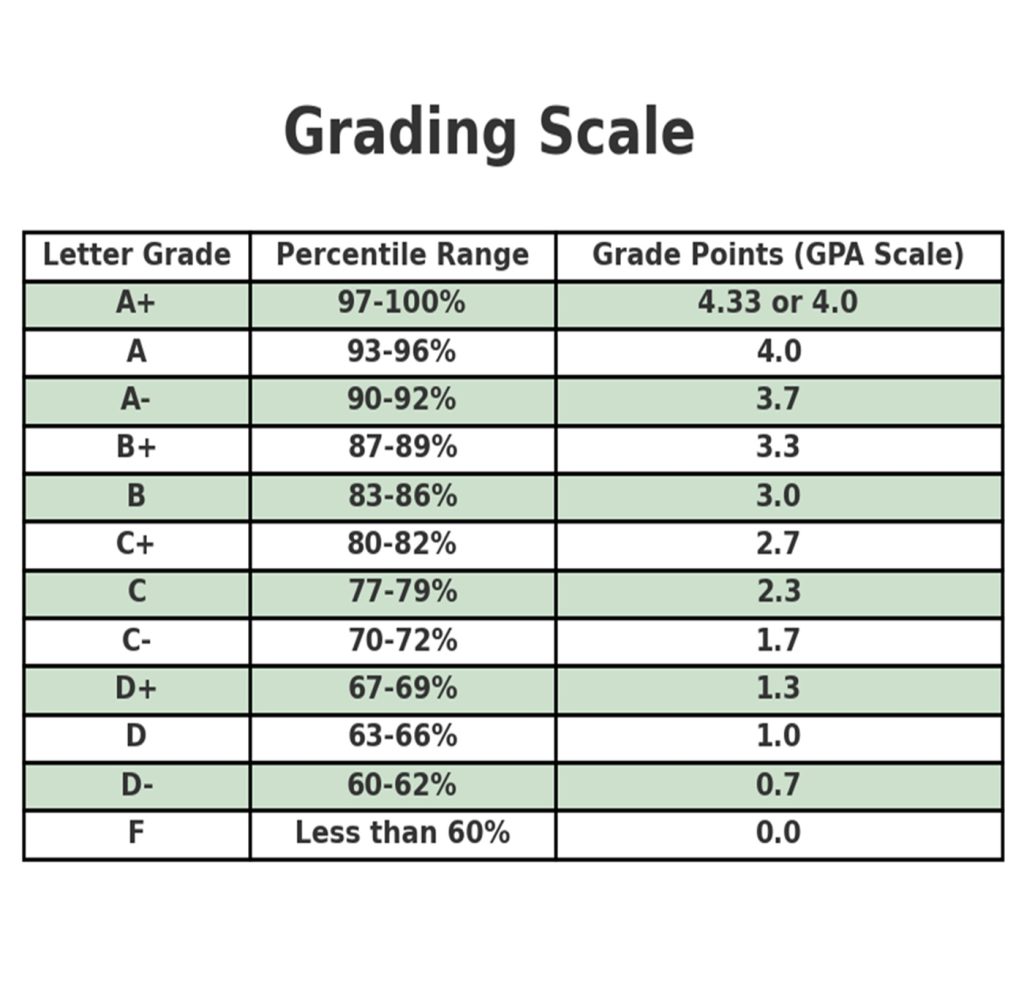
You can also refer to the following Grading Scale:
Weighted Average: How It Impacts Your GPA.
When calculating GPA, one key distinction is between weighted and unweighted GPAs:
- Unweighted GPA treats all courses equally, regardless of difficulty. Grades are converted into standard values, typically on a 4.0 scale.
- Weighted GPA takes into account the difficulty of the courses. For example, honors, AP, or International Baccalaureate (IB) courses often carry more weight, with grade values exceeding the standard 4.0 scale (e.g., 5.0 or 6.0 for an A).
Weighted averages are particularly important when competing for scholarships, honors, or admission to competitive colleges. They demonstrate a student’s ability to excel in rigorous courses, providing a more comprehensive view of academic achievement.
How to Calculate GPA.
Calculating your GPA involves a few straightforward steps:
- Convert Grades to GPA Values: Assign each letter grade a numerical value based on the grading scale. For example, an A might be worth 4.0, a B worth 3.0, and so on.
- Multiply by Credit Hours: For each course, multiply the GPA value by the number of credit hours the course is worth. Courses with more credit hours have a larger impact on your overall GPA.
- Sum and Divide: Add up all the grade points and divide by the total number of credit hours to get your GPA.
Example:
| Course | Grade | GPA Value | Credit Hours | Grade Points |
|---|---|---|---|---|
| Math | A | 4.0 | 4 | 16.0 |
| History | B | 3.0 | 3 | 9.0 |
| Science | A | 4.0 | 3 | 12.0 |
| English | B+ | 3.3 | 3 | 9.9 |
| Total | 13 | 46.9 |
GPA = Total Grade Points / Total Credit Hours = 46.9 / 13 = 3.61
The US Grading Scale.
In the United States, grades are typically represented as letters (A, B, C, D, F), which correspond to a range of percentages and are converted into GPA values. Below is a standard grading scale used in many schools:
| Letter Grade | Percentile Range | Grade Points (GPA Scale) |
| A+ | 97-100% | 4.33 or 4.0 |
| A | 93-96% | 4.0 |
| A- | 90-92% | 3.7 |
| B+ | 87-89% | 3.3 |
| B | 83-86% | 3.0 |
| C+ | 80-82% | 2.7 |
| C | 77-79% | 2.3 |
| C | 73-76% | 2.0 |
| C- | 70-72% | 1.7 |
| D+ | 67-69% | 1.3 |
| D | 63-66% | 1.0 |
| D- | 60-62% | 0.7 |
| F | Less than 60% | 0.0 |
Note: An A+ grade in the U.S. grading scale typically corresponds to a 97-100% percentile. Some institutions may associate it with a GPA of 4.33 or 4.0.
Grading Scale Conversion – Letter Scale to GPA 4.0 Scale
To convert letter grades into the 4.0 GPA scale, follow this conversion chart:
| Letter Grade | Percentile Range | Grade Points (GPA Scale) |
| A+ | 97-100% | 4.33 or 4.0 |
| A | 93-96% | 4.0 |
| A- | 90-92% | 3.7 |
| B+ | 87-89% | 3.3 |
| B | 83-86% | 3.0 |
| C+ | 80-82% | 2.7 |
| C | 77-79% | 2.3 |
| C | 73-76% | 2.0 |
| C- | 70-72% | 1.7 |
| D+ | 67-69% | 1.3 |
| D | 63-66% | 1.0 |
| D- | 60-62% | 0.7 |
| F | Less than 60% | 0.0 |
4.0 Scale and 5.0 Scale.
The 4.0 scale is the most commonly used GPA system, especially in high schools and colleges across the United States. However, some schools employ a 5.0 scale, especially when accounting for weighted grades in advanced-level courses.
Key Differences:
- 4.0 Scale:
- Standard for unweighted GPAs.
- No extra weight is given for honors or AP courses. For example, an A is always worth 4.0, regardless of course difficulty.
- 5.0 Scale:
- Incorporates weighted GPAs.
- Higher-level courses receive additional weight. For example:
- A in an AP class = 5.0.
- B in an AP class = 4.0.
Conversion Example:
| Course | Grade | 4.0 Scale | 5.0 Scale |
| AP Biology | A | 4.0 | 5.0 |
| Honors English | B | 3.0 | 4.0 |
| Regular Math | A | 4.0 | 4.0 |
For students pursuing competitive college admissions or scholarships, the weighted GPA (5.0 scale) provides a more accurate reflection of academic rigor.
How to Improve Your GPA: Practical Guidelines for Graduate Students.
Improving your GPA is a nuanced process that varies from person to person. While there is no universal formula, adopting certain habits and strategies can contribute to better academic performance. The following recommendations, though not foolproof, are grounded in common practices that promote effective learning, which may ultimately lead to a higher GPA.
1. Consistently Attend Classes
As a graduate student, every class represents a valuable opportunity to deepen your understanding of the subject matter. While it may sometimes feel tempting to skip sessions—especially if the material appears repetitive or the instructor seems unengaging—attending classes has clear advantages:
- Access to Information: Professors often provide critical insights, updates, or exam details during lectures that may not be communicated elsewhere. Missing class could result in gaps in your knowledge or missed deadlines.
- Interactive Learning: Questions raised by classmates or discussions during lectures can introduce fresh perspectives or clarify confusing topics. These interactions help solidify your understanding of complex concepts in ways that self-study cannot always achieve.
- Building Relationships: Attending and actively participating in class allows your professor to connect your name, face, and contributions to your performance. This can make them more inclined to assist you during emergencies, clarify difficult topics, or provide support when needed.
Engagement during class not only enhances your knowledge but also signals your commitment, which can foster a favorable impression among faculty members.
2. Develop a Thoughtful Approach to Planning
Effective planning is crucial for managing the demands of graduate studies. The strategies below can help you maximize your time and effort:
- Understand Your Learning Style: Different people learn differently—some thrive in long, uninterrupted study sessions, while others prefer frequent breaks. Reflect on what works best for you and align your study habits accordingly.
- Stay Organized: Keep your notes, assignments, and course materials well-structured. During lectures, focus on capturing key ideas and concepts in a way that facilitates review later. Your notes should supplement your learning, not just record the lecture.
- Manage Your Time: Balancing coursework, research, and personal responsibilities can be challenging. Prioritize tasks, create a realistic schedule, and set aside specific times for each subject or project. Avoid overloading yourself with more courses or commitments than you can reasonably handle.
- Review Regularly: Instead of cramming before exams, engage in periodic reviews of course material. Revisiting information over time reinforces your understanding and helps you retain knowledge more effectively.
Time management and strategic planning reduce stress, enhance productivity, and create space for deeper learning, all of which contribute to improved academic performance.
3. Optimize Your Study Habits
To improve your GPA, focus on not just studying harder but studying smarter:
- Break Down Tasks: Divide large assignments or research projects into smaller, manageable chunks, and tackle them one at a time. This approach minimizes overwhelm and ensures steady progress.
- Engage Actively with the Material: Passively reading notes or slides is less effective than active learning techniques like summarizing concepts in your own words, teaching the material to someone else, or solving practice problems.
- Clarify Confusions Promptly: If you’re struggling with a concept, seek help immediately—whether from professors, peers, or online resources. Delaying clarification often leads to larger gaps in understanding.
4. Prioritize Your Well-Being
A healthy mind and body are essential for academic success:
- Rest and Recharge: Graduate-level studies can be demanding, but working nonstop leads to burnout. Ensure you’re getting enough sleep, eating well, and making time for exercise or hobbies.
- Set Realistic Expectations: Accept that perfection isn’t always attainable. Focus on consistent improvement rather than obsessing over achieving flawless results in every assignment or exam.
By combining consistent class attendance, effective planning, strong study habits, and self-care, you can create a framework for long-term academic growth. These strategies not only improve your GPA but also enhance your overall learning experience in graduate school.
Other Calculators:
i-Ready Score Calculator: iReady Score Calculator.
i-Ready Growth Tracker: iReady Growth Tracker.
The AP US History Calculator: APUSH Score Calculator
Ultimate List of Tone Words: List of Tone Words
Updated Time Duration Calculator: Time Duration Calculator Tool.
Free Time Duration Calculator: Free Time Duration Calculator.
Paycheck Calculator: Free Paycheck Calculator.
Salary Calculator: Salary Calculator Tool.
Free Time Card Calculator: Free Time Card Calculator Tool.
Free Time Sheet Calculator: Free Time Sheet Calculator Tool.
TVöD Rechner: TVöD Gehaltsrechner.
Brutto Netto Rechner: Brutto Netto Gehaltsrechner.
IBAN Rechner: IBAN Rechner Online.
BMI Rechner: BMI Rechner Online.
KFZ Steuer Rechner: KFZ Steuer Rechner Online.
MwSt Rechner: MwSt Rechner Online.
Bürgergeld Rechner: Bürgergeld Rechner Online.
Dreisatz Rechner: Dreisatz Rechner Online.
TV-L Rechner: TV-L Gehaltsrechner.
Arbeitszeitrechner: Arbeitszeit Rechner.
Stundenrechner: Stundenrechner mit Pause.
PayPal Gebühren Rechner: PayPal Gebühren berechnen.
Free Time Clock Calculator: Free Time Clock Calculator Tool.
Updated Time Duration Calculator: Updated Time Duration Calculator.
i-Ready Score Calculator: i-Ready Score Calculator Tool.
i-Ready Growth Tracker: i-Ready Growth Tracker Tool.
The AP US History Calculator: AP US History Score Calculator.
Ultimate List of Tone Words: Tone Words List.
For updated MAP Growth RIT charts, grade-level benchmarks, and percentile tables, see NWEA MAP score charts by grade.
For MAP Language Usage RIT score ranges, grammar benchmarks, and writing-skill expectations, see NWEA MAP Language score chart.
For MAP Science RIT charts, science benchmarks, and grade-level score expectations, see NWEA MAP Science score chart.
For MAP Reading RIT scores, reading percentile charts, and grade-level reading benchmarks, see NWEA MAP Reading score chart.
For MAP Math RIT scores, math percentile charts, and grade-level math benchmarks, see NWEA MAP Math score chart.
To estimate a student’s MAP RIT score range, percentile level, and grade placement, use the NWEA MAP score calculator tool.
To monitor student growth, compare test windows, and track RIT score progress over time, use the NWEA MAP growth tracker tool.
For parent-friendly explanations of average, good, high, and gifted MAP scores, read good MAP scores by grade.
For i-Ready Reading scale scores, placement levels, and grade-by-grade reading benchmarks, see the i-Ready Reading score chart.
For i-Ready Math scale scores, placement levels, and grade-by-grade math benchmarks, see the i-Ready Math score chart.
For parent guides, student score tools, MAP charts, and i-Ready score resources, visit ReadyScores score charts and calculators.
Free Time Card Calculator: Free Time Card Calculator Online.
See the date 2 weeks from today: 2 weeks from today.
See the date 3 weeks from today: 3 weeks from today.
See the date 4 weeks from today: 4 weeks from today.
See the date 5 weeks from today: 5 weeks from today.
See the date 6 weeks from today: 6 weeks from today.
See the date 8 weeks from today: 8 weeks from today.
See the date 10 weeks from today: 10 weeks from today.
See the date 12 weeks from today: 12 weeks from today.
See the date 14 weeks from today: 14 weeks from today.
See the date 16 weeks from today: 16 weeks from today.
See the date 20 weeks from today: 20 weeks from today.
See the date 40 weeks from today: 40 weeks from today.
See the date 7 days from today: 7 days from today.
See the date 10 days from today: 10 days from today.
See the date 14 days from today: 14 days from today.
See the date 15 days from today: 15 days from today.
See the date 21 days from today: 21 days from today.
See the date 28 days from today: 28 days from today.
See the date 30 days from today: 30 days from today.
See the date 35 days from today: 35 days from today.
See the date 40 days from today: 40 days from today.
See the date 45 days from today: 45 days from today.
See the date 60 days from today: 60 days from today.
See the date 75 days from today: 75 days from today.
See the date 90 days from today: 90 days from today.
See the date 100 days from today: 100 days from today.
See the date 120 days from today: 120 days from today.
See the date 180 days from today: 180 days from today.
IQ Tests – Calculate IQ
Free IQ Test for Adults: Free IQ Test for Adults with free results
Free IQ Test for Kids: Free IQ Test for Kids with free results
Free Personality Test and Quiz: Free personality test with free results
Free Tip Calculator: Tip Calculator
FAQ – GPA Grades.
The average GPA varies by institution and program. For undergraduate programs in the U.S., the average GPA typically falls between 3.0 and 3.3.
What is a Cum Laude GPA?
- Cum Laude: Minimum GPA of 3.0, typically awarded to students in the top 25% of their class.
- Magna Cum Laude: Minimum GPA of 3.4, awarded to students in the top 10%-15%.
- Summa Cum Laude: Minimum GPA of 3.7 or higher, awarded to students in the top 5%-10%.
What is a Good GPA?
A good GPA depends on your goals:
- For Graduate School: Generally, a GPA of 3.5 or higher is competitive.
- For Employment: A GPA of 3.0 is often considered sufficient, though employers may value experience and skills over GPA.
What is the Highest GPA?
The highest GPA is typically 4.0 on an unweighted scale. On weighted scales (e.g., AP or honors courses), it can exceed 4.0, often up to 5.0 or higher depending on the institution’s grading system.
What is Cumulative GPA?
Cumulative GPA represents the overall academic performance across all semesters and courses. It is calculated by dividing the total grade points earned by the total number of credit hours attempted.
How Do I Calculate Semester GPA?
- List all courses you took during the semester.
- Record the letter grade received for each course.
- Assign point values to these grades:
- Standard Courses: A = 4 points, B = 3 points, C = 2 points, D = 1 point, F = 0 points.
- Weighted Courses (AP or Honors): A = 5 points, B = 4 points, C = 3 points, D = 2 points, F = 0 points.
- Sum up all assigned points.
- Count the total number of courses.
- Divide the total points by the number of courses to determine your semester GPA.
How Do I Calculate Major GPA?
To calculate your major GPA:
- List only the courses specific to your major.
- Assign point values to the grades (A = 4, B = 3, C = 2, D = 1, F = 0).
- Add up the total points.
- Divide the total points by the number of major-specific courses.
What Will My GPA Be After This Semester?
To project your GPA:
- Combine all past and current courses with their respective grades.
- Assign point values to the grades:
- Unweighted: A = 4, B = 3, C = 2, D = 1, F = 0.
- Weighted: A = 5, B = 4, C = 3, D = 2, F = 0.
- Calculate the total points and divide by the total number of courses.
How Do You Calculate Unweighted Cumulative GPA?
- List all completed courses and their grades.
- Assign unweighted point values (A = 4, B = 3, C = 2, D = 1, F = 0).
- Add up the total points.
- Divide the total points by the total number of courses.
How Do I Calculate GPA from My Transcript?
- Identify all letter grades on your transcript.
- Convert each letter grade into its numerical equivalent (A = 4, B = 3, etc.).
- For each semester, sum up the points from all courses.
- Add the semester totals together.
- Divide by the total number of courses for your cumulative GPA.
How Important is GPA in College?
The importance of GPA depends on your goals:
- Scholarships: Many require a minimum GPA for eligibility.
- Honors Societies and Clubs: Often have GPA requirements.
- Graduate Programs: GPA is a key factor for admissions.
- Employment: While not always crucial, some employers and fields may prioritize a strong GPA.
How to Get Straight A’s in College
- Attend Classes: Regular attendance helps with understanding material.
- Stay Organized: Use planners or digital tools to manage deadlines.
- Engage with Professors: Attend office hours and seek feedback.
- Prioritize Study Time: Schedule regular study sessions.
- Join Study Groups: Collaborate with peers for enhanced learning.
- Maintain Balance: Get adequate sleep and manage stress.
How Accurate is This College GPA Calculation?
Our GPA calculator is accurate to two decimal places and provides a reliable estimate based on the input data.
Can I Round Up My GPA?
You can round your GPA to the nearest tenth (e.g., 3.48 rounds to 3.5). However, rounding to the nearest whole number (e.g., 2.81 to 3.0) is generally not permitted.
Are Pass/No Pass Courses Factored In?
No, Pass/No Pass courses are not included in GPA calculations.
How Can a Strong GPA Help Me Get Scholarships?
A high GPA demonstrates academic commitment and can make you a competitive applicant for merit-based scholarships. Many programs require GPA verification through transcripts.
Can a Low GPA Prevent Me from Getting into My Desired College?
A low GPA does not automatically disqualify you. Admissions committees often review applications holistically, considering extracurriculars, leadership, and essays in addition to GPA.
Can a High GPA Guarantee College Acceptance?
No. While a high GPA strengthens your application, admissions decisions also weigh test scores, recommendations, essays, and extracurricular involvement.
How Much Does GPA Matter for College Admissions?
GPA is a significant factor in admissions, showcasing your ability to handle academic rigor. However, it’s often considered alongside other elements such as essays, interviews, and test scores.
Please also visit our EZ grader calculator for our Quickgrade calculator, used for quiezzes, tests and assignments.
Thank you very much! The Gpa calculator works very accurately.